
Yesterday, June 26 2015, the Tsuut’ina Nation celebrated Treaty Day, a day of celebrations capped off with a firework finale at the Grey Eagle Entertainment Centre. The day marks the establishment of the Tsuut’ina reserve with the signing of a Treaty 132 years ago.
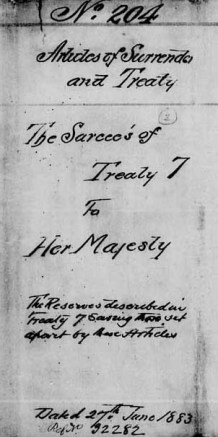
(Articles of Surrender and Treaty – the Sarcee’s of Treaty 7 to Her Majesty – IT 332. Docket Title Page portion. 1883. Library and Archives Canada)
Treaties and Reserves
The Tsuut’ina Nation first entered into a Treaty with the British Crown in 1877 with the signing of Treaty 7 in September of that year. This Treaty initially created a reserve at Blackfoot Crossing, near Gleichen Alberta, that was to be jointly shared between the Tsuut’ina, the Siksika and the Kainai Nations1. Following the disappearance of the Buffalo from the Alberta plains in the following years, and unrest with the shared reserve, the Nation moved near Fort Calgary in 1880. The Nation endured further hardships in the years follwing the signing of Treaty 7, and in the summer of 1881 discussions began with representatives of the Canadian Government for the creation of a new and separate reserve. After scouting potential locations, the Tsuut’ina settled along the Fish Creek that fall, on land that would soon be formally granted as a reserve.2
On June 27 1883, a new Treaty, as a supplement to Treaty 7, was agreed to by Chief Bull Head, Many Horses, Eagle Robe, Big Plume and Painted Otter. The new Treaty established the Tsuut’ina Nation reserve that we know today, having been surveyed the year before, and consisting of 108 square miles of land between Calgary and Bragg Creek.3
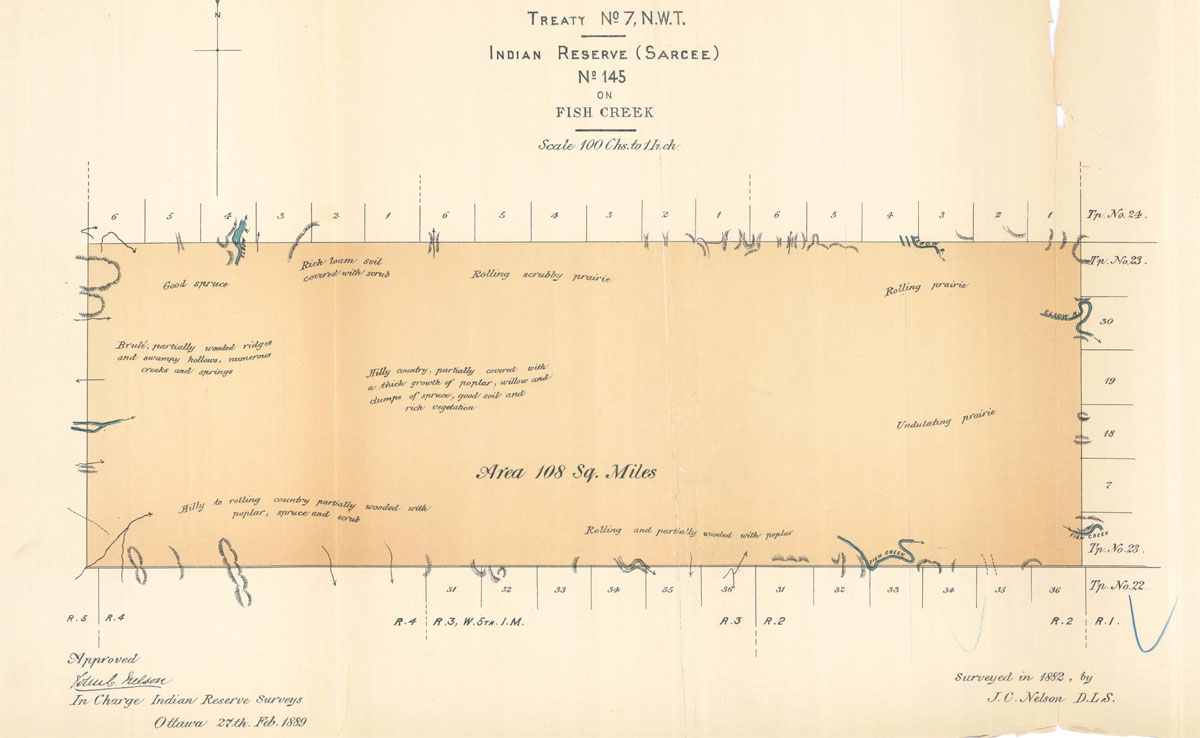
(Tsuut’ina reserve, surveyed 1882. Descriptions and Plans of Certain Indian Reserves in the Province of Manitoba and the North-West Territories, 1889. Nelson.)
Despite several surrenders and land sales over the years, the reserve borders have remained largely the same as was first granted in 1883. The only addition of land (above the initial allocation) happened this year, as a result of the Southwest Ring Road land swap; the additional lands that were added to the reserve in May of 2015 marked the first net-increase to the reserve since its establishment.
—–
For an oral account of the events leading up to the establishment of the Tsuu T’ina reserve in 1883, you can view the excellent discussion with Tsuu T’ina elder Hal Eagletail: https://vimeo.com/40184903 (beginning at 11:52). Also see the article “The ‘Sarcee War’: Fragmented Citizenship and the City” by Patricia K. Wood.
—–
Sources
1) Treaty No. 7 (Copy of Treaty and Supplementary Treaty No. 7 between Her Majesty the Queen and the Blackfeet and Other Indian Tribes, at the Blackfoot Crossing of Bow River and Fort Macleod). 1877. Retrieved June 27 2015 http://www.aadnc-aandc.gc.ca/eng/1100100028793/1100100028803
2) The ‘Sarcee War’: Fragmented Citizenship and the City. Patricia K. Wood. 2006.
3) Articles of Surrender and Treaty – the Sarcee’s of Treaty 7 to Her Majesty. 1883. Library and Archives Canada – IT 332
 Calgary Ring Road
My great-grandfather, “Old” David One Spot, was present at the signing of Treaty No. 7 and served as a witness to this historic moment. He was one of the last surviving witnesses to the treaty, living to the remarkable age of 103 before passing in 1968. I am a direct descendant of Old David One Spot.
His son—my grandfather—Edward (Eddie) One Spot, was a gifted entertainer who travelled the world, sharing his talents and culture. My father, William Robert One Spot, carried on the One Spot traditions with pride and dedication until his passing in 1977.
I sincerely hope that those providing historical information today are not intentionally omitting or overlooking my family’s legacy. It was through the kindness, generosity, and open-hearted spirit of my ancestors that many others were welcomed into our small band. Without that spirit of inclusion, many of today’s Nation members would not exist as part of the Sarcee people.
To see this history forgotten—or worse, erased—is deeply painful and frustrating. Our story matters, and it deserves to be acknowledged with the respect it has earned.
Hi, I appreciate you taking the time to write.
My post was focused on the 1883 Treaty No. 7 addendum, not the original Treaty No. 7 from 1877. The Nation representatives who were formal witnesses of that addendum are conveyed in my post according to the written document, although there were almost certainly many more who were present at that time. There was no attempt to omit anyone from the historical record.
I agree that this history matters, and that it is important to record and preserve the family history you mention. I hope that you would consider starting your own blog (or similar) to ensure that history can be captured accurately, and acknowledged in a way that might benefit future generations.
Thank you!